Chemical safety and SDS folders — what Safe Work actually expects
A current SDS, a GHS label on every decanted bottle, and a van that is not a mixed chemical cupboard — that is the standard inspectors and clients already use, not a paperwork hobby.
Editorial desk · 9 April 2025 · Updated 20 January 2026
Safe Work Australia does not inspect your trolley. The state and territory WHS regulators do, and they do it against the model Work Health and Safety Regulations in every jurisdiction except Victoria, which runs the Occupational Health and Safety Act 2004 and its own hazardous-substances framework. The practical expectation is the same wherever you clean: the people using the product can see what it is, what it does, and what to do when it goes wrong. A laminated “chemicals are dangerous” poster in the depot does not meet that test.
This is a chemicals and equipment problem and a WHS problem at the same time. The folder is not a tender decoration. It is how a night cleaner decides not to tip two leftovers into one bucket.
What the law is actually asking for
If you are a person conducting a business or undertaking and you use, handle or store hazardous chemicals at a workplace, the model WHS Regulations require you to prepare and keep a hazardous chemicals register. The register is a list of the product names plus the current safety data sheet for each one. It must be readily accessible to workers who use those chemicals and to anyone else likely to be affected — which on a client site includes the facility manager and, in an emergency, the fire brigade.
Safe Work Australia’s own guidance is blunt about access. The register should be easy to use and available when it is needed, not when the office next opens. A folder that lives in a locked admin room while the work happens in a school at 7pm is not readily accessible. A SharePoint library that nobody on the night shift can log into is the same failure with better branding.
Manufacturers and importers must prepare the SDS. Suppliers must provide the current SDS when the product is first supplied and again when it is first supplied after an amendment. Your duty as the contractor is to obtain that SDS — the Australian manufacturer or importer’s SDS, not a random overseas PDF — before the product is used. A third-party “generic bleach” sheet does not discharge the duty on its own.
From 1 January 2023, stock manufactured or imported in Australia must be classified, labelled and given an SDS under GHS 7, the seventh revised edition of the Globally Harmonized System. Older GHS 3 labels can remain on product that was made or imported before that date until the stock runs out. The SDS you keep at the workplace is expected to be GHS 7. If the classification changed, you obtain the updated sheet when the product is next supplied, or as soon as practicable after that supply and before you use it.
None of that requires you to recite the regulation number to a cleaner. It does require that the sheet in the folder matches the bottle on the trolley.
Current SDS, not a 2016 photocopy
“Current” is the word clients and inspectors use when they flick the date on page one. Manufacturers are expected to review an SDS at least every five years, and whenever they learn new hazard information. A sheet that still shows GHS 3 pictograms and a discontinued emergency number is a finding, even if the product “hasn’t changed”.
Build a habit that survives a busy month:
- One register line per product, using the name on the label, not the nickname on the roster (“toilet stuff”).
- SDS filed in the same order as the register.
- A review date on the register itself, so you can see which sheets are approaching five years.
- When a product is discontinued, strike it from the register. Do not leave orphan sheets that imply you still use a discontinued acid.
- When a supervisor buys a special-purpose graffiti remover for one job, it goes on the register before it goes in the van.
Digital systems are fine. They fail when the only login sits with the compliance officer, or when the app needs a signal in a basement plant room. Pair the system with a site pack for the products that live on that site. Hospitals and food plants will often demand that pack as a condition of induction. They are not being precious. They are tired of contractors who arrive with a mystery spray.
GHS labels on the bottle you actually pour from
The original jerry can usually arrives with a decent GHS label: product identifier, signal word, pictograms, hazard and precautionary statements, supplier details. The failure is decanting. Cleaners pour into unmarked spray bottles because the trigger on the 5-litre is useless, or because a colour-coded bottle is easier to grab. An unlabelled bottle is an unlabelled hazardous chemical. The model regulations expect a label in English on the container you use.
A workable decant label is not a novel. It needs the product name as it appears on the parent SDS, the GHS pictograms and signal word that still apply at the use dilution if the SDS says the dilution remains hazardous, the key hazard statements, and your business name with a phone number. If the SDS says the ready-to-use dilution is not classified as hazardous, you still label the bottle with the product name and dilution. Nobody should have to sniff it to tell it from rinse water.
Do not write “bleach” on a bottle of sodium hypochlorite and a bottle of a quaternary disinfectant. They are not the same product and they are not interchangeable when a nurse asks what you used on a bed rail. The infection-control argument starts with being able to name the active.
Dilution control belongs next to the label. Unmeasured “glugs” turn a neutral cleaner into a residue machine and turn a disinfectant into either a waste of money or a surface that cannot be used for the dwell time on the SDS. Closed-loop dosing, marked pumps, or pre-diluted RTU are all more reliable than a junior on a Sunday guessing.
Mixing bleach and acids is not a folk tale
Sodium hypochlorite (the bleach in most Australian washroom routines) releases chlorine gas when it meets acids. Toilet descalers, some rust removers, and a surprising number of “grout brighteners” are acidic. The same bleach mixed with ammonia or with some quaternary products can give chloramines. Cleaners still do this when they chase a stain that survived the first product. The result is a trip to emergency and a site that will not have you back.
The control is boring and it works:
- One product in the bucket or the bottle.
- Rinse if you must change chemistry on the same surface.
- Store acids away from oxidisers. That includes the crate in the van and the shelf in the school cupboard.
- Do not decant leftovers into a “mixed” bottle to save a trip to the drain.
The SDS sections on incompatibility and first aid are there for this, not for the tender appendix. If the operator cannot find Section 7 and Section 4 in under a minute, the folder is in the wrong place.
Hydrogen peroxide blends, chlorine dioxide kits and any “activated” system need the same segregation discipline. Read the manufacturer’s mixing order. Do not invent a concentrate because the pump is slow.
PPE is not the first control
The hierarchy of controls still applies to a spray bottle. Elimination and substitution come first: do you need an acid at all, or will a correctly diluted neutral and a dwell do it? Engineering next: dosing units, closed systems, ventilation in a windowless toilet. Administrative after that: procedures, job rotation, the rule that you do not fog a small amenity with a product that wants respiratory protection. PPE last — gloves, eye protection, apron, respirator — sized and stocked for the people who actually work, not one box of medium nitrile in the office.
Nitrile is the default glove for most detergent and disinfectant work. It is not magic. Check the SDS for breakthrough guidance on solvents and strong acids. Change gloves when they are contaminated, not at the end of the fortnight. Eye protection means something that covers the side when you are pouring at chest height in a van. A respirator is a last step and a trained one; if the SDS puts you in that territory, you also need a conversation about whether the product belongs on a night trolley at all.
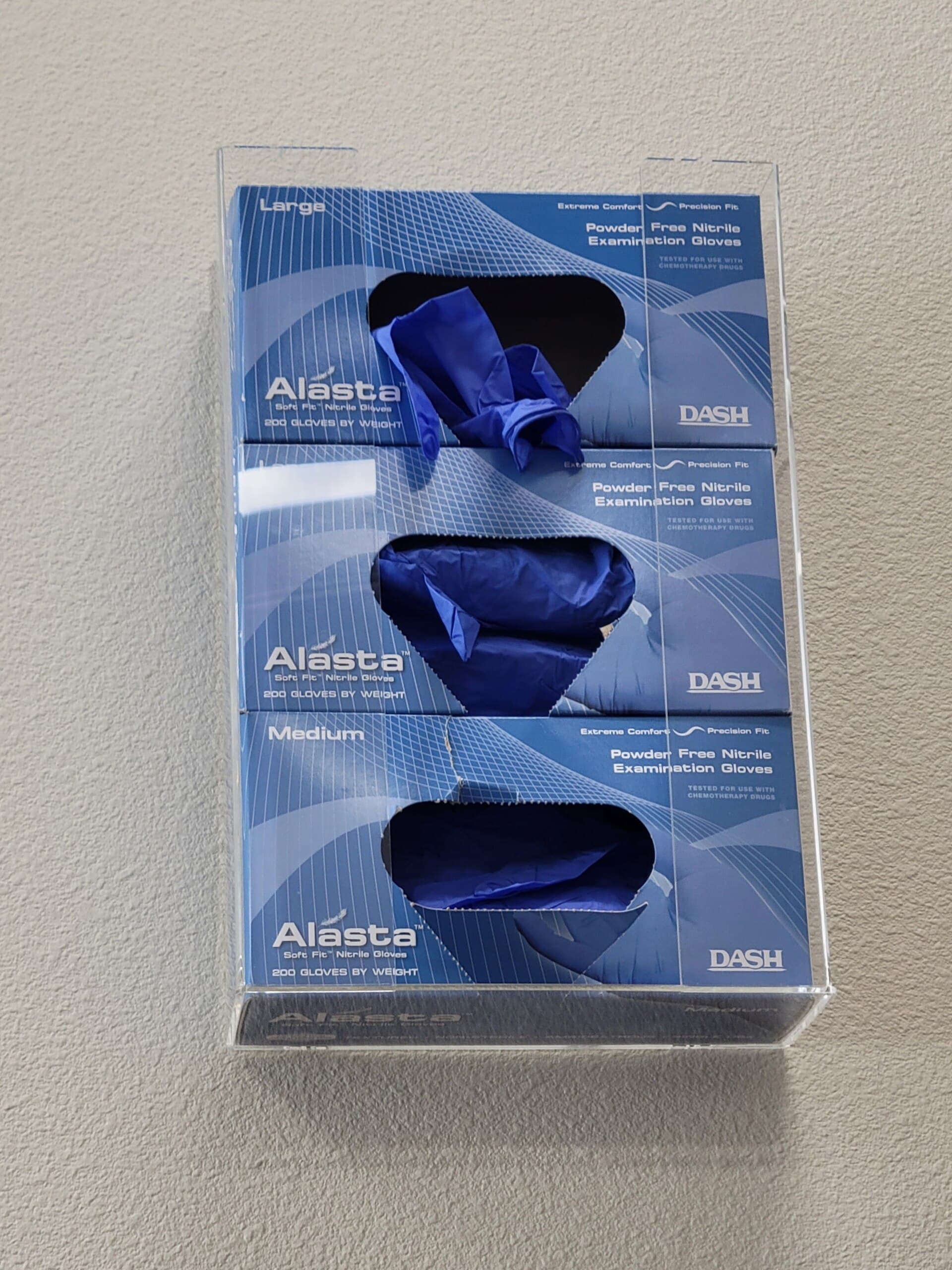
Store PPE where the chemical lives. A glove dispenser on the depot wall is useful. A glove dispenser in the school cleaners’ cupboard is what the shift will use. See microfibre and colour-coding for the same logic applied to cloths: the right thing has to be in the right bucket, or people will grab the nearest rag.
The van is a workplace
Regulators and clients have both worked out that the second workplace is the Hyundai. Heat in an Australian van turns some products into a pressure experiment and wrecks others. Caps pop. Labels cook off. A bottle of acid on its side leaks into a box of pads.
Treat the vehicle as a store:
- Upright, capped, in trays or crates that will hold a leak.
- Acids separated from bleach and from alkali.
- Original containers where you can; labelled decants where you must.
- No food, no drink, no clean uniform sitting on the chemical tray.
- A spill kit that matches what you carry — absorbent, a bag, gloves, goggles — not a decorative bag of kitty litter under the passenger seat.
- Quantities that belong to the day’s work. A van is not a mini warehouse for the whole book of work.
If you carry enough hazardous chemical to wander into manifest or placard territory, stop and get advice. Most cleaning vans never should. The contractors who get there did it by treating the vehicle as overflow storage.
Site cupboards are the client’s building and your workplace. Do not leave unlabelled decants “for the weekend crew”. Do not store petrol for a blower next to the oxidiser. Do not block the eyewash or the exit with a tower of empties.
Training records that would survive a Monday morning
Induction is not a signature on a generic “I have read the SDS” line. Useful training is product-and-task specific: this disinfectant, this dilution, this dwell, this surface; this acid, this toilet, this ventilation; this is what you do if it hits your eye. It is also literacy-aware. A workforce that includes people working in a second language needs pictograms, a demonstrated pour, and a supervisor who checks the first week, not a ten-page English quiz.
Keep the record against the person and the product set they are allowed to use. When you change the washroom chemical after a tender, retrain. When a labour-hire cleaner arrives for one night, they are still your worker for WHS purposes on that shift — see workers compensation and labour hire. If they cannot use the product safely, they do not use it.
Refresher training belongs on the calendar, not “when we get around to it after Easter”. So does a drill for a splash and a drill for a chlorine-gas mistake. You want the first time they use the eyewash to be with water, not with panic.
Clients will ask for these records at tender and after an incident. So will the insurer. So will the regulator if a worker is hospitalised. The modern slavery and labour questionnaires now sit in the same pack as the SDS register; both are about whether you actually control the work.
What “good” looks like on a real site
A competent contractor can walk a stranger to the cupboard and, without theatre, put a hand on the register, the current SDS, the labelled bottles, the glove box, the spill kit and the dilution chart. The night cleaner can name the product in the yellow bottle and say what it must not meet. The van has the same logic at smaller scale. The office has the manufacturer contacts and the waste path for empties and for anything that has become clinical or chemical waste.
That is what Safe Work’s framework is pointing at, once you strip out the fear and the poster campaigns. It is also what a facilities manager means when they say they want a “professional chemical system”. They do not mean a more expensive fragrance. They mean they will not find a mystery liquid in a soft-drink bottle under the sink.
Write the system once. Audit it when the product list changes, when you win a laboratory or a food plant, and when you change floor machines or pads that drag a new chemistry with them. The folder is the easy part. The discipline on the trolley is the job.
Questions contractors ask
- Is a supplier PDF on a phone enough to satisfy the SDS duty?
- It can be part of access, but it is not a substitute for a current Australian manufacturer or importer SDS that workers can reach during the shift, including when reception is locked and the signal is poor. Keep a site folder or an offline pack for the products that are actually on the trolley.
- Do consumer bleach and supermarket spray need an SDS on a commercial site?
- If you use a product the way a household would, in household quantities, the model WHS Regulations give a limited consumer-product exception. The moment you buy in bulk, decant, or use it as a workplace process chemical, treat it as a workplace hazardous chemical and get the SDS.
- What is the first thing an inspector looks for in the van?
- Labels you can read, incompatible products that are not sharing a crate, a spill kit that is not under a pile of pads, and whether the operator can find the SDS for the product in their hand. The folder on the office shelf is the second visit.